
Respiratory protection is not just a piece of equipment. It is a system, and a system that fails at any point puts the people wearing the equipment at serious risk of exposure to airborne pathogens. Ontario healthcare workers learned this lesson with brutal clarity during the COVID-19 pandemic, and the province’s regulatory expectations around respiratory protection programs have evolved significantly in response. If your facility does not have a written respiratory protection program with documented fit testing, you are not meeting current standards. This guide walks you through every component of a compliant Ontario respiratory protection program, from hazard assessment to recordkeeping.
What Is a Respiratory Protection Program and Why Is It Required?
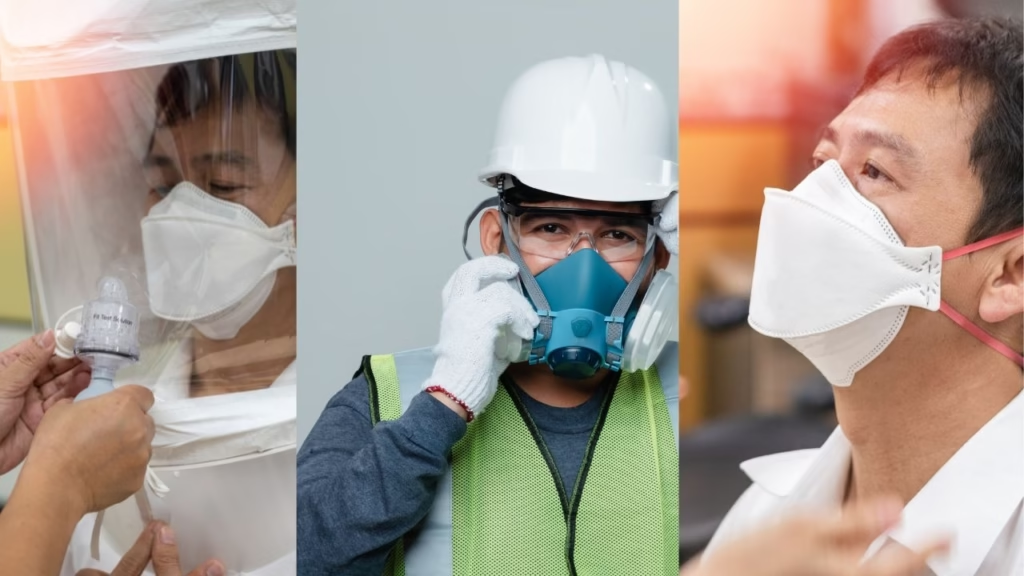
A respiratory protection program is a written, employer-administered system that governs the selection, use, maintenance, and evaluation of respiratory protective equipment in the workplace.
In Ontario healthcare settings, this program is required by the Occupational Health and Safety Act and the regulations that flow from it, including O. Reg. 67/93 (Health Care and Residential Facilities) and the broader industrial regulation framework.
The respiratory protection programs resource from Infection Shield outlines the specific obligations that Ontario healthcare employers carry under this framework and where most facilities currently have documentation gaps.
A respirator without a program around it is not protection. It is equipment that may or may not work on any given day, for any given worker, against any given exposure.
Ontario Regulatory Framework: OHSA, CSA Z94.4, and PHO Guidance
OHSA Obligations for Respiratory Protection
The Occupational Health and Safety Act requires Ontario employers to take every reasonable precaution to protect workers from workplace hazards, including exposure to airborne infectious agents.
Where respiratory hazards exist and cannot be eliminated through engineering or administrative controls, the employer must provide appropriate respiratory protective equipment and a program to ensure its correct use.
CSA Standard Z94.4: The Technical Benchmark
CSA Z94.4, the Selection, Use, and Care of Respirators standard, is the technical benchmark referenced by Ontario regulators for respiratory protection program requirements.
This standard specifies the components of a written program, the methods of fit testing that are acceptable, the frequency of fit testing, medical evaluation requirements, and the training content that respirator users must receive.
Ontario facilities that have not aligned their respiratory protection programs with CSA Z94.4 should treat this as an urgent compliance gap. The PHO public health Ontario guidelines resource provides context on how provincial public health guidance interfaces with occupational health regulation in this area.
Understanding when respiratory protection is required begins with a structured hazard assessment.
Hazard Assessment: When Respiratory Protection Is Needed
Identifying Airborne and Droplet Transmission Risks
Respiratory protection is required when workers may be exposed to airborne or droplet-transmitted pathogens that cannot be adequately controlled through environmental measures alone.
In healthcare settings, this includes aerosol-generating medical procedures (AGMPs), caring for patients with known or suspected airborne infections including tuberculosis, measles, or varicella, and situations where the transmission route of a novel or emerging pathogen has not yet been definitively characterized.
The Hierarchy of Controls Applied to Respiratory Hazards
Respiratory protective equipment sits at the bottom of the hierarchy of controls, meaning that elimination, substitution, engineering controls (such as negative pressure rooms), and administrative controls (such as scheduling policies) must all be considered and implemented to the degree reasonably practicable before relying on PPE.
This hierarchy does not diminish the importance of respiratory protection. In practice, healthcare settings typically require multiple layers of controls operating simultaneously, with respiratory protection as a critical final layer.
The infection transmission science and prevention strategies resource explains the science of airborne and droplet transmission that underlies the need for tiered respiratory protection in clinical environments.
Types of Respirators Used in Healthcare Settings
N95 Filtering Facepiece Respirators
N95 respirators filter at least 95 percent of airborne particles and are the standard respirator for healthcare workers exposed to airborne infectious agents. They must be NIOSH-approved and, critically, must be fit tested to the individual wearer to provide the protection they are rated for.
An N95 respirator that does not seal properly to the wearer’s face provides no more protection than a surgical mask against airborne pathogens. This is why fit testing is the cornerstone of any respiratory protection program, not an optional add-on.
Powered Air-Purifying Respirators and Other Options
Powered air-purifying respirators (PAPRs) use a motor to draw air through a filter and deliver it to a hood or helmet that covers the head. PAPRs do not require fit testing in the same way as tight-fitting respirators and may be appropriate for workers who cannot achieve an adequate fit with an N95 due to facial features or medical conditions.
Elastomeric half-face and full-face respirators are also used in some healthcare settings and must be fit tested to the individual wearer.
Your respirator selection must match the hazard. PHO published guidance on respirator selection for healthcare workers that aligns with the CSA Z94.4 requirements for hazard-based selection.
The appropriate respirator is only protective when it fits the individual worker, which requires formal fit testing.
Fit Testing Methods: Qualitative vs. Quantitative
Qualitative Fit Testing
Qualitative fit testing (QLFT) uses the wearer’s sense of smell or taste to detect leakage of a challenge agent such as saccharin, Bitrex, or isoamyl acetate into the respirator facepiece during a series of exercises.
QLFT is acceptable for half-facepiece respirators and does not require specialized instrumentation beyond the challenge agent protocol kit. However, it relies on the wearer’s subjective response to the challenge agent, which can introduce variability. It is not acceptable for respirators with an assigned protection factor above 10, which excludes its use for full-face respirators.
Quantitative Fit Testing
Quantitative fit testing (QNFT) uses instrumentation to measure the actual concentration of particles inside and outside the respirator facepiece, producing a fit factor score that does not rely on the wearer’s subjective response.
QNFT is required for full-face respirators and is considered the more reliable method for half-face respirators where precision is important. PortaCount instruments using condensation particle counting are the most widely used technology for QNFT in Ontario healthcare settings.
Both methods must include a defined series of exercises specified under CSA Z94.4 to replicate the range of movements a worker makes during typical tasks.
Fit testing method selection must align with the respirator type and the facility’s resources for conducting testing.
Fit Testing Frequency and Trigger Events
Annual Fit Testing as the Minimum Requirement
CSA Z94.4 requires that respirator users be fit tested at least annually using the specific make, model, and size of respirator they will use on the job. Annual testing is a minimum baseline, not a ceiling.
Many Ontario healthcare facilities conduct fit testing annually and record the results in individual employee respiratory protection files.
Trigger Events That Require Repeat Fit Testing
Fit testing must be repeated outside the annual cycle when a worker experiences significant weight change (typically 10 pounds or more), facial surgery or injury that changes the facepiece sealing surface, significant dental work affecting facial structure, or when the worker is assigned a different make, model, or size of respirator.
Workers who report difficulty breathing or discomfort with their current respirator must be reassessed. A poor fit that the wearer has adapted to is not a passing fit test.
The infection prevention guide for healthcare workers addresses the broader personal protective equipment obligations that sit alongside your respiratory protection program.
Fit testing tells you the respirator fits. Seal checks tell you the worker put it on correctly before each use.
Seal Checks, Donning, and Doffing Procedures
User Seal Checks Before Each Use
A user seal check is a quick positive or negative pressure test that the worker performs each time they don their respirator to confirm the seal has been achieved correctly for that specific wearing event.
A positive pressure check involves covering the exhalation valve and breathing out gently, checking for air leakage around the facepiece. A negative pressure check involves covering the inhalation valves, inhaling gently, and checking that the facepiece collapses slightly toward the face and holds without air leaking in.
These checks must be performed every time the respirator is donned, including during the same shift. They do not replace fit testing but confirm correct donning after the fit test establishes that an adequate seal is achievable.
Doffing Sequence and Contamination Prevention
Doffing a contaminated respirator incorrectly is a documented route of self-contamination. Staff must remove the respirator by handling the straps, not the facepiece, immediately after leaving the patient’s room or contaminated space, and must perform hand hygiene immediately following removal.
Filtration facepiece respirators must not be shared between workers and must be discarded when visibly soiled, damaged, or wet. Reusable elastomeric respirators must be cleaned and stored according to the manufacturer’s instructions between uses.
Correct donning and doffing depends entirely on the quality of training your workers receive.
Medical Clearance and Accommodation Considerations
When Medical Evaluation Is Required
CSA Z94.4 requires that workers be medically cleared before they are required to wear a respirator. Medical evaluation identifies conditions that may contraindicate tight-fitting respirator use or that require accommodation through alternative respiratory protection approaches.
Conditions including cardiac disease, pulmonary conditions, claustrophobia, and certain musculoskeletal issues affecting the ability to don and doff the respirator may be identified through medical evaluation and require individual accommodation planning.
Accommodation Options for Workers Who Cannot Wear Tight-Fitting Respirators
Workers who are medically unable to wear tight-fitting respirators may be accommodated through PAPR use, modified work assignments that reduce exposure to airborne hazards, or a combination of administrative and engineering controls that reduce the risk to an acceptable level.
Accommodation plans must be documented and reviewed regularly. A worker’s medical status may change over time, and the accommodation must be updated to reflect current clinical and regulatory requirements.
Your respiratory protection program must address accommodation as a planned element, not an afterthought triggered by an individual complaint.
Training Requirements for Respirator Users
Mandatory Training Content Under CSA Z94.4
Workers assigned respirators must receive training that covers why respiratory protection is needed, what the limitations of their specific respirator are, how to select the correct respirator for the assigned task, how to don and doff correctly, how to perform a user seal check, how to identify when the respirator needs to be replaced, and how to store and maintain their respirator.
Training must be provided before initial use and refreshed annually or when program changes are made.
Training Documentation and Competency Records
Training records must include the date of training, the content covered, and the worker’s acknowledgment of receipt. Competency verification through observed donning and doffing is the highest standard of training documentation and is expected in healthcare settings with significant airborne exposure risk.
The IPAC staff training guide from Infection Shield provides a curriculum framework for respiratory protection training that meets Ontario’s documentation and content expectations.
Well-trained workers with documented compliance form the foundation of a program that holds up under regulatory review.
Program Administration, Recordkeeping, and Audit Readiness
Written Program Requirements
Your respiratory protection program must be in writing and must include a hazard assessment, respirator selection criteria, fit testing schedule and methods, medical evaluation process, training plan, maintenance and inspection procedures, and program evaluation methodology.
This document must be reviewed and updated at least annually or when significant changes to the workplace hazard profile occur.
What Auditors and Inspectors Review
Ontario Ministry of Labour, Immigration, Training and Skills Development (MLITSD) inspectors reviewing respiratory protection compliance will request the written program, fit test records for all respirator-assigned workers, medical evaluation documentation, training records, and evidence of annual program review.
Gaps in fit testing records, missing medical evaluations, or outdated written programs are common findings. The IPAC compliance best practices and regulations resource provides a useful framework for self-auditing your respiratory protection program against current Ontario expectations.
A compliant respiratory protection program does not just protect workers. It demonstrates organizational commitment to safety that regulatory bodies and accreditation reviewers take seriously.
FAQ
Is annual fit testing legally required in Ontario healthcare settings?
Yes. CSA Z94.4, referenced by Ontario’s OHSA regulatory framework, requires annual fit testing at minimum. Additional fit testing is required when trigger events such as significant weight change, facial surgery, or respirator model changes occur.
Can a surgical mask replace an N95 respirator during aerosol-generating procedures?
No. Surgical masks are not respirators and do not provide the same level of protection against airborne particulate exposure. During aerosol-generating medical procedures involving patients with known or suspected airborne infections, a fit-tested N95 respirator is required.
What happens if a worker cannot achieve an adequate N95 fit during testing?
Different N95 makes, models, and sizes should be trialled to find one that achieves an adequate fit. If no tight-fitting respirator can be fitted, accommodation through PAPR use or modified work assignment must be explored and documented in the worker’s respiratory protection file.
How long does an N95 respirator remain effective if stored between uses?
Filtration facepiece respirators should be inspected before each use for damage, soiling, or moisture. Manufacturer guidance on storage and reuse should be followed. During declared shortages, extended use or limited reuse protocols based on regulatory guidance may apply, but these must be formally documented.
Who is responsible for administering the respiratory protection program in a healthcare facility?
The employer is responsible for the program, but administration is typically delegated to occupational health, infection control, or health and safety personnel. IPAC consultants can assist with program development and audit readiness where internal expertise is limited.
If your facility’s respiratory protection program has not been reviewed and updated since the pandemic, there is a strong chance it does not reflect current CSA Z94.4 requirements or PHO expectations. Infection Shield works with Ontario healthcare organizations to develop, audit, and strengthen respiratory protection programs. Book a free consultation and get expert guidance on closing your compliance gaps before your next inspection.